
Where Craft Truly Begins
Before the line, before the silhouette, before even the idea, there is the gesture.
We often speak of the finished product. We observe its shape, its balance, its allure. But what we see is only the consequence. The origin lies elsewhere — in the hand.
Artisanal leatherwork does not begin with an object. It begins with a relationship between the material and the one who works it. A measured tension. A precise cut. A calibrated pressure.
The gesture precedes the object because it determines its quality.
Understanding the Material
Full-grain leather is not subdued. It is understood. Its density, its suppleness, its fiber direction require attentive reading. A poorly oriented cut weakens the structure. Excessive skiving compromises the edge. A fold that is poorly anticipated permanently marks the surface.
An experienced hand does not force. It adjusts.
In the workshop, nothing is automatic. Even when a machine is used, it extends a gesture prepared upstream. The marking of the stitching lines, the positioning of the pieces, the tension of the thread: each step is defined before execution.
Precision Over Spectacle
The gesture is not spectacular. It is precise.
A hand-executed saddle stitch illustrates this discipline. Two needles, one thread, constant tension. Each stitch is independent. If one gives way, the whole remains intact. This technique is not chosen for its image. It is chosen for its reliability.
The Responsibility of the Gesture
Made-to-order production imposes this level of attention. When a piece is created for a specific individual, there is no room for approximation. The gesture becomes accountable. It commits to the object’s durability.
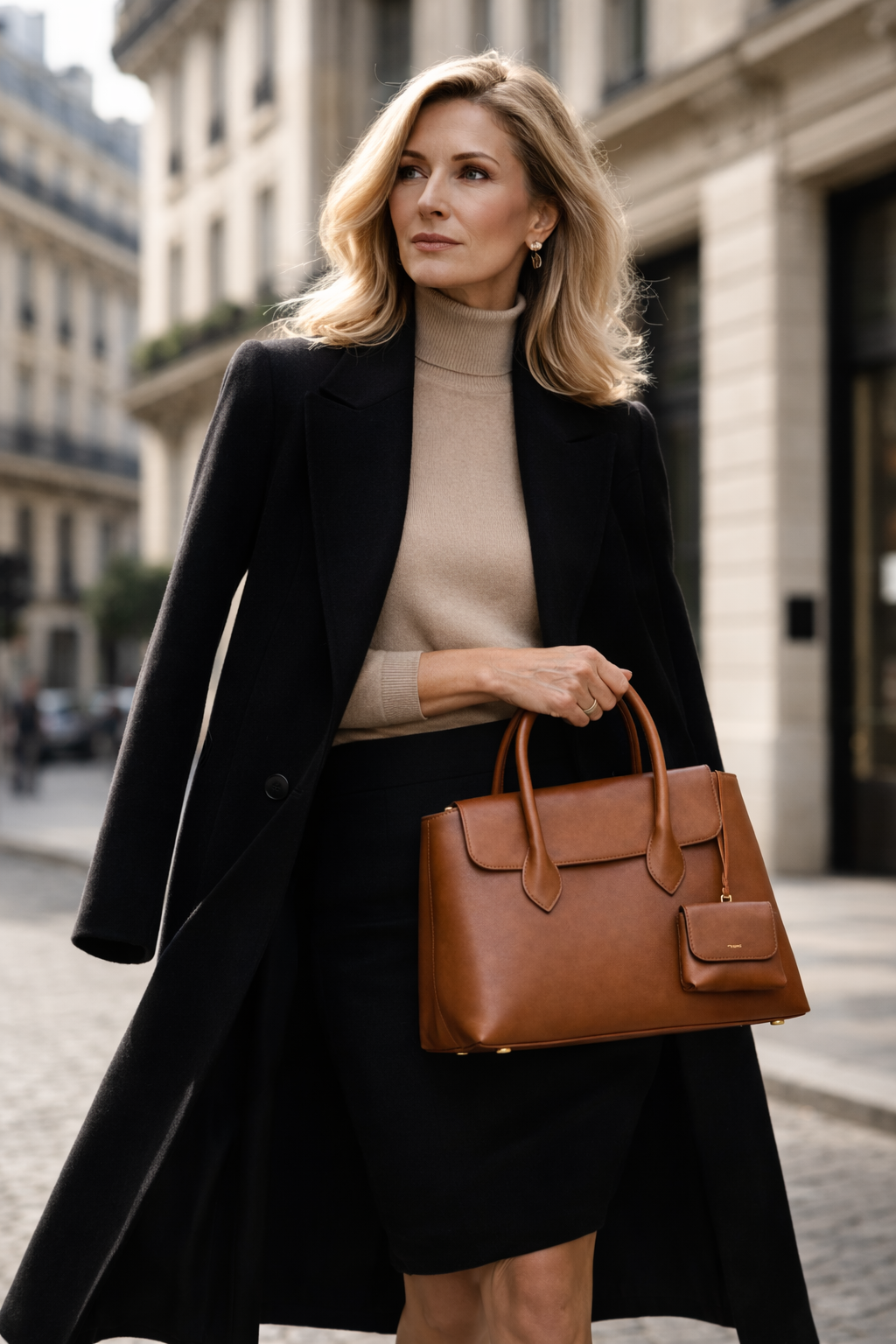
A work bag, for example, immediately reveals the quality of the gesture. It carries weight. It endures tension at attachment points. The handles must be anchored with precision. The base must be reinforced without excessive rigidity. Balance relies on a succession of invisible technical decisions.
The gesture precedes the form.
It makes it possible.
Coherence as a Measure of Mastery
In high-end leatherwork, mastery is not measured by apparent complexity. It is measured by coherence. A clean cut. A consistent edge. An aligned stitch. These elements express continuity of gesture.
The experienced hand anticipates. It knows how the leather will respond in six months, in a year. It adjusts thread tension accordingly. It respects the natural elasticity of the hide.
Living material demands this humility.
Precision Versus Speed
Producing in series, at high speed, alters the relationship to the gesture. Accelerated repetition reduces attention. Precision becomes statistical. Acceptable defect replaces absolute standards.
Conversely, producing less makes it possible to preserve the initial intention. Each piece retains the same vigilance. The hand remains attentive.
The gesture before the object is also a matter of responsibility. A bag must not merely appeal at first use. It must accompany years. It must withstand temperature variations, friction, and load.
When the Hand Gives Form
A 1.7 mm full-grain calfskin provides the necessary structure. A 0.7 mm full-grain lambskin lining brings interior refinement. But without the appropriate gesture, these materials remain inert.
The hand transforms material into a durable object.
Within Maison Cartling J., a design is validated only after being confronted with the gesture. If a line compromises strength, it is adjusted. If a proportion weakens the base, it is corrected. Aesthetics never prevail over coherence.
The Trace of Intention
What one holds, therefore, is not merely a bag. It is the trace of a succession of technical decisions.
The gesture precedes the object because it contains the intention.
It reveals whether priority was speed or precision.
It reveals whether the material was respected or exploited.
It reveals whether the piece was made to endure or simply to deliver.
True luxury does not display itself.
It is felt in accuracy.
—
Quality is never improvised. It is built, gesture after gesture.

Leave a Reply