
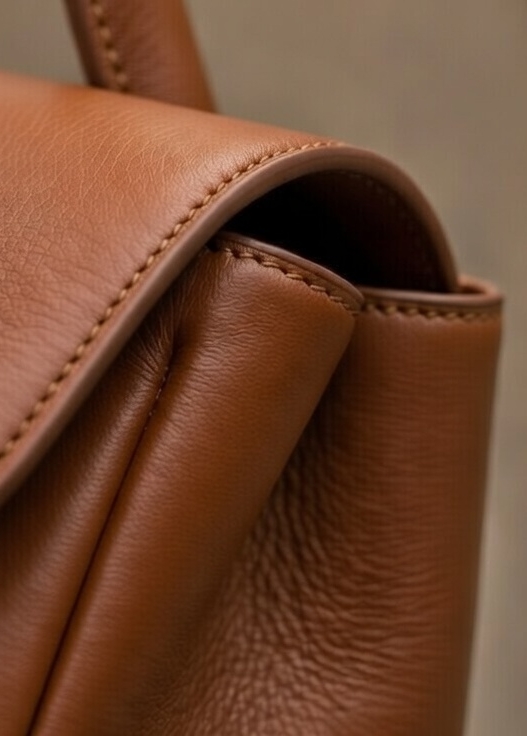
One often observes the silhouette of a bag.
Its line.
Its proportion.
Its overall balance.
But connoisseurs begin elsewhere.
They look at the stitching.
A stitch is never a trivial detail. It is the visible expression of a certain level of exacting standards. It reveals mastery of gesture, the quality of leather preparation, and the precision of assembly. It does not lie.
The Architecture of Stitching
The regularity of the stitch: precision in every perforation.
In high-end artisanal leatherwork, stitching is architecture. It holds the structure, absorbs tension, distributes load. It ensures that the bag retains its form despite weight, despite time.
To observe a stitch is to understand how the bag was conceived.
The Regularity of the Stitch
The regularity of the stitch is the first indicator. A constant distance between each perforation indicates carefully prepared marking. Nothing is improvised. Each hole is positioned according to a precise rhythm — neither too close, which would weaken the leather, nor too far apart, which would compromise strength.
The thread itself is revealing. A thread too fine for thick leather signals cost-saving. A thread too thick on supple leather creates unattractive rigidity. Balance depends on an understanding of the material.
In the case of full-grain calfskin, the stitching must accompany the density without constraining it. It must reinforce the structure without weighing down the line. Inside, a full-grain lambskin lining requires a different calibration — finer, more precise.
Alignment and Precision
Alignment is a second indicator. A perfectly straight stitch is not accidental. It presupposes consistent skiving, clean cutting, and exact positioning of the pieces before assembly. If the cut is imprecise, the stitching will attempt to compensate; but the tension will be visible.
Edges also speak. Stitching placed close to a well-burnished edge reflects coordination between stages: cutting, skiving, gluing, stitching, finishing. Each phase depends on the previous one. The slightest approximation carries forward.
The Saddle Stitch: A Benchmark
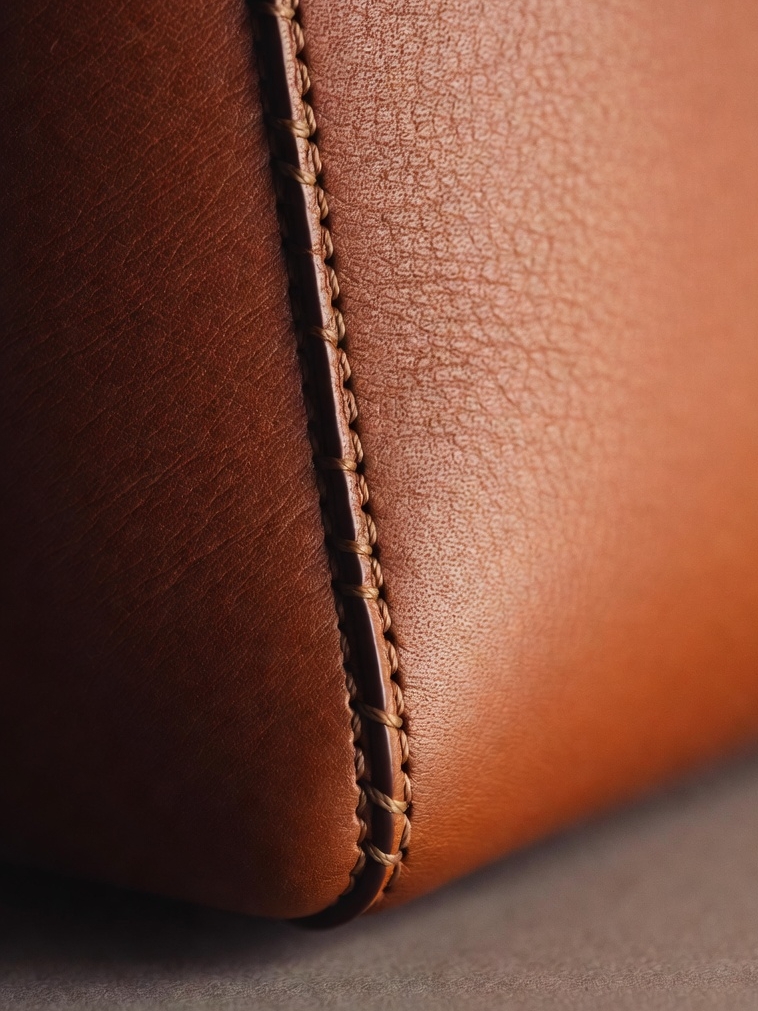
Alignment and edge finishing: harmony between stages.
The saddle stitch, executed by hand with two needles, remains a benchmark in exceptional leatherwork. It creates a crossed stitch that reinforces strength. If one thread were to break, the whole does not unravel. Each stitch is independent. This technique demands time, precision, and constant tension.
Stitching in Mass Production vs. Made-to-Order
In mass production, speed dominates. The machine accelerates. Pace dictates rhythm. The stitching remains functional, but rarely expressive. It fulfills a minimal role.
In made-to-order production, the relationship changes. The time devoted to each piece allows for finer attention. The stitching becomes almost a language. It expresses the relationship between hand and material.
The Demands of a Work Bag
Strategic Reinforcement Areas
A work bag like EVIDENCE – Chancellor, in particular, tolerates no structural weakness. It carries a laptop, documents, sometimes books. The handle attachments endure constant tension. Poorly conceived stitching will gradually give way. Controlled stitching will absorb the load.
These are the strategic areas to examine: the base, the attachments, the corners. A well-designed bag presents reinforced stitching in these areas without compromising visual refinement.
How Leather Accepts the Stitch
The quality of full-grain leather also reveals itself in how it accepts perforation. Dense fiber allows for a clean stitch. Leather that is overly corrected or excessively treated frays around the hole. The stitching then betrays the nature of the material.
What Stitching Truly Reveals
To look at stitching, therefore, is to look beyond appearance.
It is to understand whether the bag was designed to endure.
Within Maison Cartling J., stitching is never mere assembly. It is integrated from the drawing stage. The distance from the edge, the choice of thread, the tension, the finishing — all are defined in advance. Nothing is left to improvisation.
What a stitch reveals, ultimately, is a house’s philosophy.
The pursuit of speed or the pursuit of permanence.
Material economy or respect for structure.
Appearance or coherence.
Stitching is a discreet line, yet it contains the entire intention.
—
Strength is not proclaimed. It is demonstrated, stitch after stitch.

Leave a Reply