
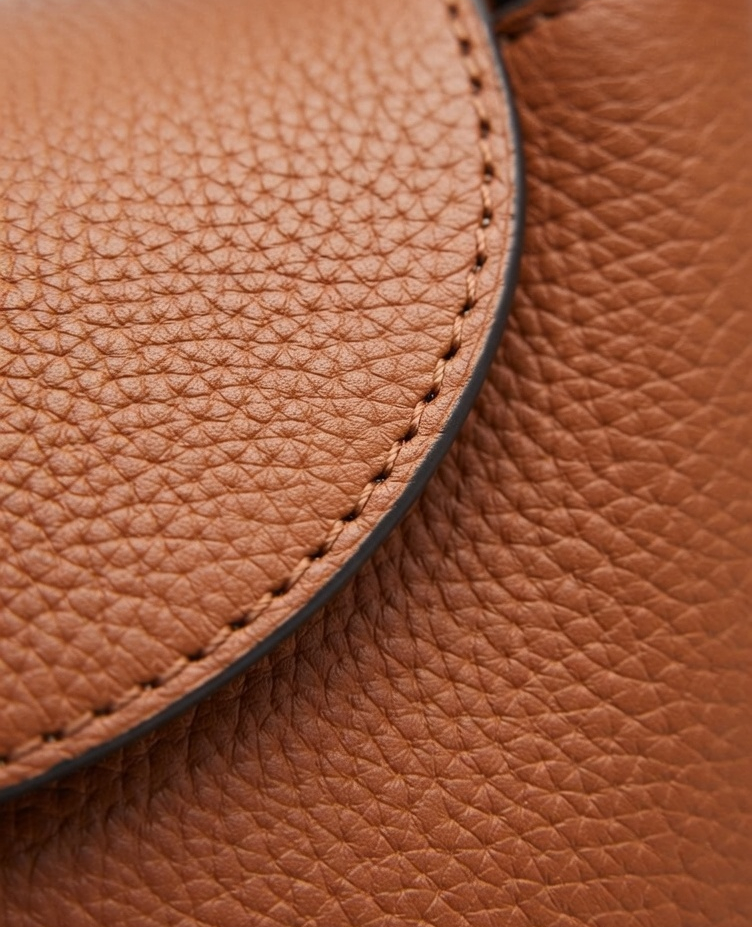
There is a moment every woman recognises. You are standing in front of a bag — or a screen — and something pulls you in. The shape. The colour. The way the leather catches the light. And then comes the price. And then comes the question nobody seems to answer clearly: is this actually worth it?
This guide exists to answer that question honestly.
What Full-Grain Leather Actually Means
The term gets used everywhere. On luxury websites, in product descriptions, in press releases from brands that manufacture at scale. But full-grain leather is not a marketing phrase. It is a precise technical classification — and understanding it changes how you evaluate every bag you will ever consider.
Leather comes from the hide of an animal. That hide has layers. The outermost layer — the one that faced the world, developed natural markings, breathed, and aged — is called the grain. Full-grain leather preserves this layer entirely. Nothing is sanded away. Nothing is buffed smooth. The surface you touch is the surface that existed before any human intervention.
This matters for three reasons.
Strength. The grain layer contains the most tightly woven fibres in the entire hide. Removing it — as corrected or split leather does — weakens the material fundamentally. Full-grain leather is structurally stronger because it is structurally complete.
Patina. Over time, full-grain leather develops a patina — a deepening of colour and character that comes from use, light, and the oils in your hands. A corrected leather surface, sealed with pigment and coating, cannot do this. It ages by degrading. Full-grain leather ages by becoming more itself.
Authenticity. Because the natural surface is preserved, no two full-grain leather bags are identical. Slight variations in texture, subtle differences in grain — these are not imperfections. They are the signature of a material that was once alive.
Discover The Sovereign — the Women’s luxury full-grain leather reference bag
The Grade Nobody Mentions
Not all full-grain leather is equal. Within the classification, there is a further distinction that most brands quietly ignore: the grade of the hide itself.
Hides are graded based on the density of the grain, the absence of natural marks, and the consistency of the surface. The highest grades — representing less than 5% of global leather production — come from animals raised in specific conditions, with hides that have developed exceptional density and uniformity.
A bag made from top-grade full-grain leather will hold its architectural line without internal reinforcement. It will maintain its shape across years of daily use. It will develop a patina that becomes more refined, not more tired.
When a brand specifies the grade of their leather — not just the type — that specificity is a signal. It means the material choice was deliberate, traceable, and held to a standard that most production cannot meet.
What Separates a Luxury Structured Bag from the Rest
The word structured describes a bag that holds its shape independently. No stuffing required. No collapse when set down. An architectural silhouette that remains consistent from morning to evening, empty or full.
Achieving this without internal plastic reinforcement is the mark of true high-end leather craftsmanship. It requires a hide dense enough to support itself, cut with precision, assembled with controlled stitch tension, and finished with hand-painted edges that seal and protect every cut surface.
Each of these steps takes time. Each requires a trained hand. None of them can be automated without compromising the result.
Discover The Westmore — the Women’s luxury full-grain leather compact version
This is why the price of a genuine structured luxury bag reflects something real. You are not paying for a name. You are paying for the hours, the material, and the expertise that make the object behave the way it does — today, and ten years from now.
The Questions Worth Asking Before You Buy
Not every bag described as luxury deserves the word. Before committing, these are the questions that cut through the noise.
What grade is the leather? Full-grain is the category. The grade within that category is what determines quality at the highest level. If a brand cannot or will not answer this, the leather is likely standard commercial grade.
Is the interior lined in full-grain leather? Many bags use fabric, split leather, or synthetic lining inside — materials that degrade faster and feel different to the touch. A bag lined in full-grain lambskin signals that the same standard was applied throughout, not just on the surface you see first.
Are the edges hand-finished? Machine-finished edges are sealed quickly and uniformly. Hand-painted edges — applied in multiple layers, polished between each — create a finish that protects the cut leather for the life of the bag. You can feel the difference.
Does the bag carry a serial number? Individually numbered pieces signal limited production and traceable craftsmanship. It is not a guarantee of quality in itself, but it is consistent with the standards of a house that controls its output carefully.
Discover The Chancellor — the Women’s luxury full-grain leather reference bag. When you need more room
Why This Matters More Than the Logo
There is a quiet shift happening in the way certain women relate to luxury. Less interest in visible branding. More interest in what the object actually is — how it was made, what it will become, whether it was worth the investment five years later.
A bag without a logo asks something different of the woman who carries it. It asks her to know why she chose it. To have done the work of understanding what she is holding. To need no external validation for a decision made entirely on her own terms.
Full-grain leather at its highest grade — structured, hand-finished, individually made — is the material expression of that position. It does not announce itself. It simply endures.
And for the woman who already knows what she wants, that is precisely the point.
A Final Note on Investment
A well-made full-grain leather bag, properly maintained, will outlast most things in your wardrobe. Conditioning once or twice a year. Storage in a dust bag. Kept away from prolonged direct light. That is all it asks.
In return, it will develop character you cannot buy — only earn, through years of use. The patina that forms on calfskin after three winters of daily carry is not replicable. It is yours. It is the record of where the bag has been, and who carried it.
That is what full-grain leather at this level actually means. Not a category on a label. A material that improves with the life you bring to it.
Discover the EVIDENCE collection — six models in uncorrected full-grain Italian calfskin, individually numbered.
Looking for the complete picture? This article is part of our guide to exceptional leather goods — covering materials, construction, style, and how to choose well. Read the full guide →
