
There’s a moment many women know: you buy a bag “in leather”, love it for a few months, and then something happens. The coating starts peeling at the corners. The surface dulls, turns greyish. It’s not a question of care — it’s a question of material.
Not all bags sold as “leather” are leather in the same way. And the difference between a bag that ages badly and one that improves with the years often comes down to a single criterion: the quality of the grain.
The four main grades of leather
A calfskin hide goes through several stages of transformation before becoming a bag. One of the most important decisions a tanner — and then the leatherworker — makes is which part of the hide to use, and how to treat it.
Full-grain leather
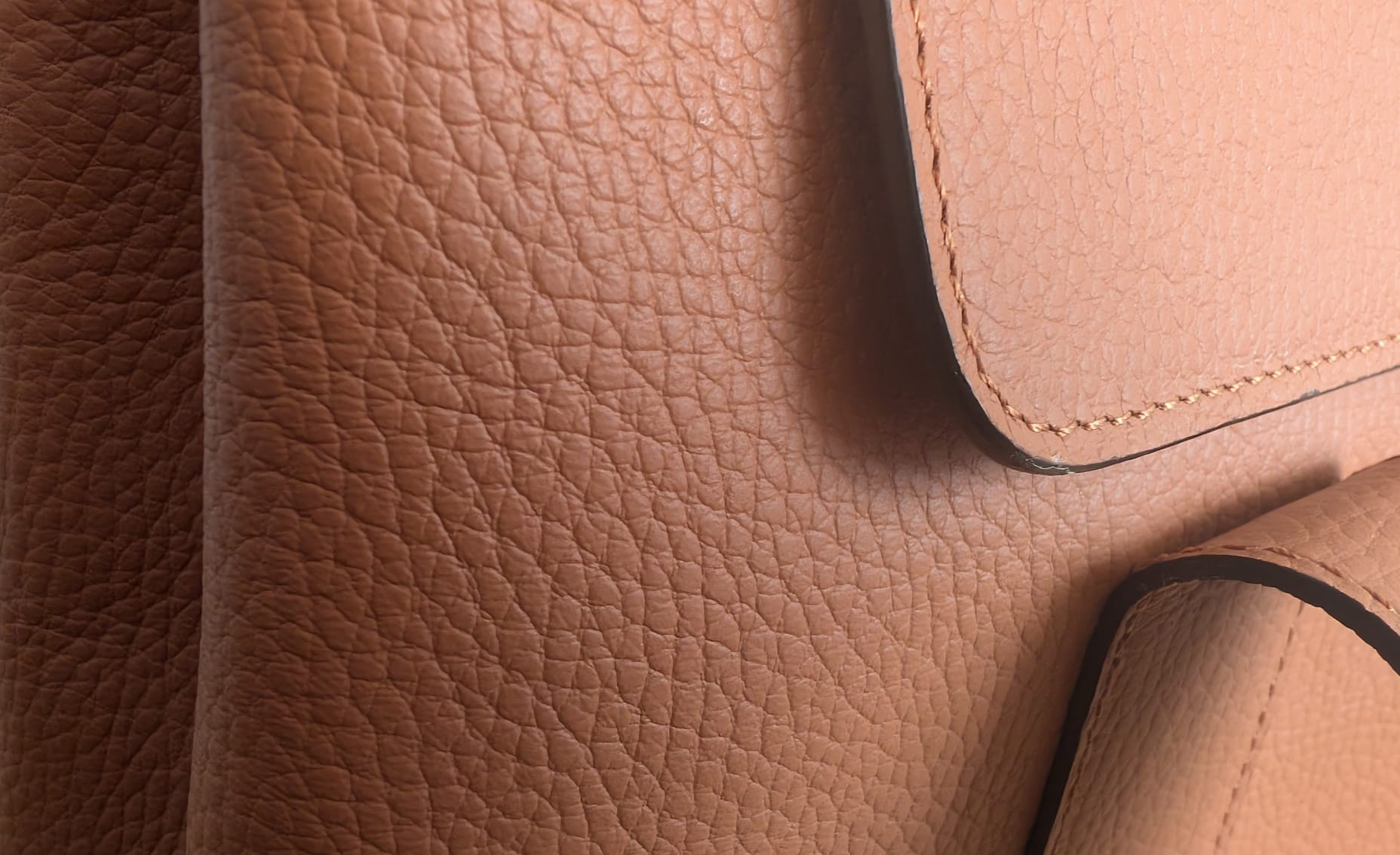
This is the outermost layer of the hide, the one that was in direct contact with the outside world. The densest, the most durable, the one whose natural structure remains intact. It isn’t sanded down or coated. The grain visible on the surface of the bag is the actual grain of the animal’s skin. Every hide is slightly different.
Corrected-grain leather
It comes from the same layer, but the surface has been buffed and coated with a synthetic finish to mask imperfections. More visually uniform, easier to produce at scale — but impervious to patina. That coating, over time, degrades.
Split leather
This is the lower layer of the hide, separated from the grain. It’s coated to give it the appearance of leather. It’s the one that peels.
Faux leather (PU, PVC)
It isn’t leather. It’s a textile coated with a plastic film. It can be perfectly honest at its price point, but it has none of the properties of genuine leather.
Most bags sold between £100 and £400 use corrected-grain leather, split leather, or a combination. It’s rarely stated clearly on the product page.
What “uncorrected full-grain” actually means
When we talk about uncorrected full-grain calfskin — the exact grade used in the EVIDENCE collection — it means the hide’s surface hasn’t been buffed or coated. It keeps its natural grain, its slight textural variations, its ability to breathe.
That absence of correction has a direct effect on touch: full-grain leather is immediately recognisable to the hand. It’s dense, slightly warm. It doesn’t feel sticky. It has a resistance and at the same time a suppleness that corrected leather cannot replicate, because that suppleness comes from the hide’s own structure, not from an industrial softener.
This is particularly noticeable on a model like the Women’s luxury full-grain leather – Sovereign — an everyday carry bag whose subtle trapeze silhouette relies entirely on the natural hold of the leather, without rigid internal structure. Or on the Westmore, whose more pronounced silhouette keeps its shape for years without distorting, precisely because the leather has its own memory.
Discover What Defines a High-Quality Structured Handbag? The 5 Criteria That Never Lie
There’s also an effect on light: full-grain leather absorbs and reflects differently depending on the angle. A corrected-grain bag is flat and uniform. A full-grain bag has areas that catch the light differently — not in a dramatic way, but in a way that gives depth to the colour. On the Women’s luxury full-grain leather – Chancellor, with its generous proportions, that depth of material is immediately visible from the front.
The only argument that really matters: patina
Full-grain leather ages. That’s its biggest drawback for manufacturers, and its greatest advantage for women who buy a bag to keep it.
With use, full-grain leather develops a patina: it absorbs very slightly the natural oils of the skin, takes on a slightly darker tone at contact points, the corners soften. Nothing visible in the first year — but after three, five, ten years, a full-grain bag has a presence that no new bag has.
Corrected-grain leather doesn’t patina. Its synthetic coating can’t absorb anything. What it does instead is wear: corners peel, the surface cracks at fold lines, colour desaturates. It isn’t the leather aging — it’s the coating degrading.
This is why the great leather goods houses work exclusively in full-grain on their permanent collections. A bag returning to after-sales every season for surface damage would ruin their reputation. Full-grain prevents that — at the cost of more rigorous hide selection and more demanding cutting skills.
How to recognise full-grain leather before you buy
A bag’s product page can be photographed to make corrected-grain look as good as full-grain. Studio lighting, post-production treatment, the angles chosen — all of it erases the difference on screen.
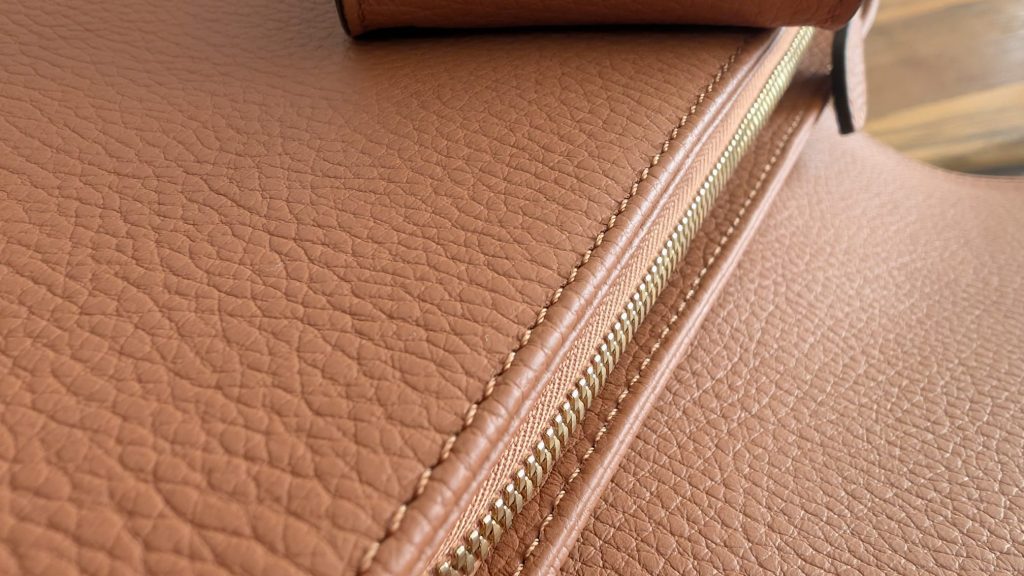
What distinguishes the two in reality is touch and observation in natural light — two things you can’t assess online. But there are reference points.
Discover The Luxury Full-Grain Leather Bag: What Nobody Tells You Before You Buy
Read the product description carefully
Look for the exact terms: “uncorrected full-grain”, “full grain”, “top grain uncorrected”. “Genuine leather” alone means nothing — split leather is also genuine leather. “Premium leather” says nothing either. If the grain quality isn’t mentioned, it’s almost always because it would work against the brand.
Discover Which elegant and timeless luxury leather bag should you choose?
Look at the detail photographs
Check the corners and edges. Full-grain leather on a well-constructed bag shows painted or dyed edges, not glued or plastic-piped borders. The corners have a slight natural suppleness rather than rigid perfection. In front-facing photographs, look for slight grain variations — corrected-grain leather is visually uniform to the point of monotony.
Assess the price
A genuine full-grain calfskin bag under 400–500 euros new is rare, because the material alone has a cost. Not impossible, but rare — and when it does happen, there’s usually a concession elsewhere: cheap hardware, synthetic lining, simplified construction.
Read the manufacturing description
Brands that genuinely use full-grain mention it, because it’s a selling point. Those that remain vague about the material generally don’t have a reason to be vague.
Why so few brands actually use it
The short answer: because it’s demanding.
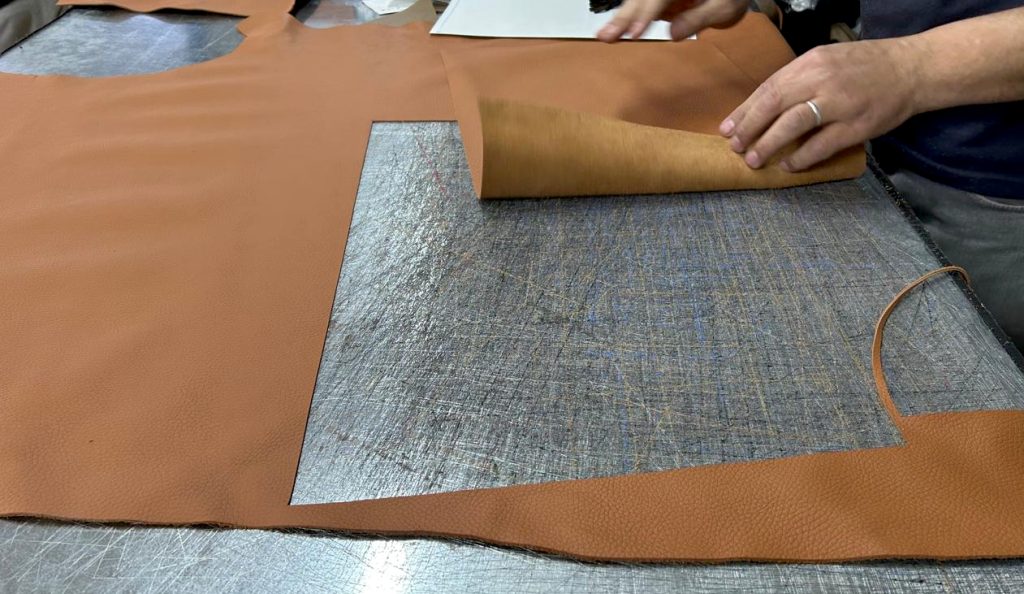
Uncorrected full-grain leather is selected hide by hide. Every hide has natural variations — a healed scratch, a faint growth mark, a difference in density from one side to the other. These variations are evidence of living leather. They’re also a problem for production that aims for absolute uniformity.
A leatherworker using full-grain has to sort, orient each hide differently, adjust the cut based on the specific characteristics of each piece. It takes time, generates more waste, and requires a trained eye.
Corrected-grain solves that problem: the coating layer uniformises everything. Every hide gives the same visual result. Production standardises.
The EVIDENCE collection uses uncorrected full-grain Italian calfskin — the same grade of leather as among the great leather goods houses. That’s not a marketing argument. It’s a manufacturing constraint that shows in the price, in the cutter’s skill, and in what the bag will be in ten years.
What it means for you
A full-grain calfskin leather bag isn’t an impulse purchase. It isn’t something you replace often either.
It’s an object that asks for minimal care — a nourishing leather cream twice a year, storage in a dust bag away from direct light when not in use — and that in return lasts. Not three seasons. Years.
The Women’s luxury full-grain leather – Sovereign carries a full day without losing shape, without marking at the handles. The Women’s luxury full-grain leather – Chancellor takes everything asked of it — documents, travel, the unexpected — without losing its line. The Women’s luxury full-grain leather – Westmore, with its more compact form, keeps that presence that well-made objects have, even when empty. And the Women’s luxury full-grain leather – Vanguard, designed for evenings, has the lightness of full-grain leather worked thin, that drapes rather than holds.
Women who have in their wardrobe a bag bought fifteen years ago, still reaching for it because it’s more beautiful now than the day they bought it — it’s almost always a full-grain bag. The material did what it knows how to do.
That’s the promise every model in the EVIDENCE collection carries.
Discover the EVIDENCE collection — six models in uncorrected full-grain Italian calfskin, individually numbered.
Looking for the complete picture? This article is part of our guide to exceptional leather goods — covering materials, construction, style, and how to choose well. Read the full guide →
